Why You Should Find a Dentist Who Uses CBCT/3D Imaging
It’s incredible to see the rate at which medical technology has been advancing in recent decades, helping to improve the care and treatments available for patients around the world. In the dental industry, one of the most beneficial technologies available for dentists involves 3D dental imaging.
Regular X-Rays vs. Dental Cone Beam Computed Technology
For years, visual examinations and regular x-rays provided the information that dentists used for diagnostics and treatments. While certain dental conditions could be identified using this technology, there are other aspects of dental health that remained undetected.
Now, Dental Cone Beam Computed Technology (CBCT) is a unique type of x-ray equipment that enables the production of 3D images. Not only do these images show information about the tooth structure, but the dentist can also see details affecting the nerve pathways, soft tissues, bone health, and more. As a result, precision in treatment planning helps to minimize invasive treatments and optimize long-term dental health.
In addition to improved diagnostics, patients also benefit from the lower radiation levels required to obtain these high-quality images. The scans are viewed on a computer screen, giving the dentist access to images that can be zoomed and adjusted as needed. Not only is this format more convenient compared to old film images, but the manipulation of the scans can improve accuracy and diagnosis.
Common Uses of CBCT
When might your dentist recommend a CBCT scan? These are examples of when the 3D images can be helpful for your dental care:
- Viewing impacted teeth to plan a surgical procedure
- Preparing for orthodontic treatments
- Accuracy with the placement of dental implants
- Diagnostics for temporomandibular joint disorder (TMJ)
- Detection of potential tumors and cancerous growths
- Evaluations of jaw position, nerve canals, sinuses, and nasal cavities
- Complete information about tooth orientation and bone structure
- Identifying early signs of dental disease
What to Expect During a CBCT Scan
Rest assured; there is no reason to be worried about this dental scan. It is a painless imaging tool that improves your experience in our office. CBCT requires no special preparation. Before the scan is done, you will be asked to remove items that might interfere with the imaging, such as eyeglasses, jewelry, hearing aids, hairpins, and removable orthodontics or dental work.
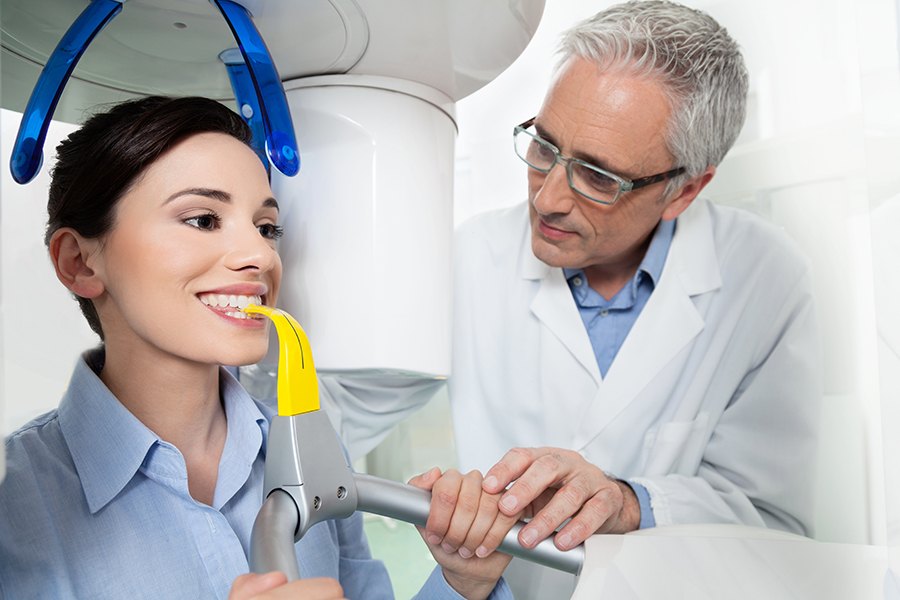
The equipment is a square-shaped machine with a rotating portion that moves around your head. A complete, 360-degree rotation is done, with multiple images captured at various angles. Then, these images are reconstructed with the final product: a single 3D image. You will need to sit still for 20 ‘ 40 seconds while the image rotation is completed.
Dedication to Dental Excellence
At myDental, we are working hard to stay current in the industry. Our offices are equipped with the leading tools in the industry, giving you access to top-notch dental services for the whole family. If you have questions about CBCT or any other equipment used in our office, then we are here to help. Call to schedule an exam at one of our convenient locations so that you can experience the latest in dental technology.
Frequently Asked Questions
CBCT imaging creates a detailed three-dimensional view of the teeth, jawbone, nerves, sinuses, and soft tissues, while traditional X-rays only show a flat two-dimensional image. This allows dentists to see hidden fractures, the exact position of impacted teeth, bone density variations, and nerve pathways. The comprehensive view leads to more accurate diagnoses and treatment planning.
CBCT scans use significantly less radiation than medical CT scans and the scan takes only 20 to 40 seconds to complete. The radiation dose is low enough to be considered safe for routine dental diagnostic use. Proper shielding and limiting the scan area to only the region being evaluated further minimizes exposure.
CBCT imaging is especially valuable for dental implant planning, root canal treatment on complex tooth anatomy, wisdom teeth extraction, orthodontic treatment planning, and diagnosing jaw joint disorders. The 3D view helps dentists plan precise surgical approaches and avoid important structures like nerves. It also helps identify problems that might be missed on traditional X-rays.
Some dental insurance plans cover CBCT imaging when it is deemed medically necessary for diagnosis or treatment planning. Coverage varies by plan and the reason for the scan. Without insurance, a CBCT scan typically costs between $150 and $500, and many offices include it in the overall treatment cost for procedures like implants.
CBCT imaging allows the dentist to measure bone density and volume precisely, identify the location of nerves and sinuses, and plan the exact angle and depth for implant placement before surgery begins. This level of precision reduces the risk of complications and improves implant success rates. A dentist can evaluate your bone structure using 3D imaging to determine the best approach for your implant.
 English
 Spanish