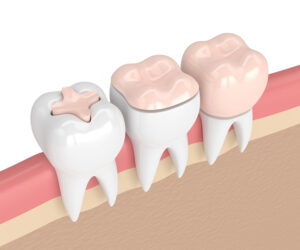
If your dentist has recently recommended a major tooth restoration, such as an inlay or onlay, then you are probably looking for more information to find the best treatment for your unique needs. While inlays and onlays have some similarities, there are differences that make each type of treatment better for certain conditions.
Our dental team is here to provide all of the information you need, as well as a personalized treatment plan based on your unique dental conditions. We invite you to reach out any time if you have questions or you would like to discuss the various dental restorative treatments that are available.
Dental Filling vs Onlay
For minor or moderate tooth damage, a basic filling might be sufficient to restore your tooth. But there are times when it makes sense to choose an inlay or onlay instead, due to the amount of tooth that must be removed due to damage or tooth decay.
Should I get an onlay or filling? Only a dentist can recommend the ideal treatment for your needs. So, the best solution is to discuss the diagnosis, look at x-rays, and then you can work with the dental team to identify the best treatment plan going forward.
Our goal is to minimize the amount of work that is necessary, which is why we might recommend a dental filling in the early stages of decay, chipped teeth, or cracks. But if the damage has progressed and a large portion of the tooth is being affected, then inlays and onlays are often the ideal treatment.
Inlay vs. Onlay Dental Treatments
Inlays and onlays differ from basic fillings because these two restorative treatments are much larger than standard fillings. Additionally, there are different processes for completing these dental treatments. An inlay or onlay is a pre-molded filling designed to match the grooves of your teeth. Once the dentist prepares the tooth for the filling, then a digital image is created to map the top portion of the tooth that needs to be restored.
Porcelain or composite materials are used to create dental inlays or onlays, designed to create a natural-looking tooth that blends in with the shape and color of the surrounding teeth. This treatment gives patients an almost invisible result: a long-lasting, durable restoration to protect the remaining areas of your teeth.
Onlay vs. Inlay: When a Dental Inlay is Your Best Option
While an inlay can be used for just a portion of the tooth, an onlay is better when there is more extensive damage. Usually, the difference between the onlay vs. inlay dental is based on the part of the tooth being affected by the damage or tooth decay. For example, if the damage is affecting the majority of the biting surface or cusp of the tooth, then a full onlay is needed to cover the entire tooth.
What is the major disadvantage of inlay? The drawback is that it doesn’t cover the whole tooth. If you are choosing between inlay or onlay treatments, then the inlay will only be recommended if the cavity is affecting the inner portion of the grooves in the tooth (not the higher points at the edges of the tooth).
What is the Advantage of Inlay and Onlay?
There are many benefits of onlay vs. inlay. Both of these treatments offer a long-term solution for repairing teeth with serious damage. One of the benefits is that you can avoid the need for dental extraction by removing the damaged area of the tooth and restoring it with an inlay or onlay.
These restorations typically last between 15 – 30 years, depending on the types of materials used and the placement of the restoration. If you need an inlay or onlay, then it makes sense to invest in the best materials that will hold up for the longest time.
What is the most common failure of inlay/onlay? It’s possible for the materials to be fractured or cracked, especially if you bite down on something that is hard. So, talk to your dentist about protecting your tooth restoration to avoid damage to the dental inlay or onlay.
Dental Inlay vs. Onlay: Call the Experts for Recommendations
You can learn about these different treatments, but it’s difficult to choose the ideal dental plan without consulting with an industry expert. A skilled dentist will evaluate the condition of your tooth and offer recommendations for an onlay vs. inlay. Additionally, our team offers other restorative dentistry services if you need a different type of treatment.
If you need an inlay or onlay, then we invite you to schedule a consultation to learn more about our restorative dentistry services. At myDental, our experienced team is always here to help. We have several locations for your convenience.
 English
 Spanish